
Root Canal
Let’s Connect
Have questions or want to schedule an appointment? Reach out to us today!
Root Canal Treatment in Scottsdale, Arizona — Gentle, Same-Day Care at Kevin harris dentist
Preserve your natural tooth at Scottsdale, Arizona with the help of root canal treatment. At Kevin harris dentist we use the latest technology, tried and tested methods and a patient-centred approach to ease pain, prevent infection and return chewing function. Schedule an appointment and enjoy a comfortable treatment experience or call now for same day care.
Save your natural tooth, relieve dental pain and prevent damage to adjacent teeth with a predictable, long-lasting root canal treatment.
Introduction
If a tooth hurts all the time, or is sensitive to hot or cold, or there is swelling surrounding the tooth, their life can be immediately thrown out of order. Some people put off treatment because they think of the pain involved or think that no other way of treatment is possible other than extraction. The reality is that today root canal therapy is an extremely successful technique for saving a tooth and for relieving pain and preventing infection.
The purpose of root canal treatment is to remove the infected or inflamed pulp from the inside of the tooth, clean the canal system and seal it, thus preventing reinfection of the tooth. This helps to retain the natural tooth structure and provides normal chewing and appearance. Root canal is indicated when the decay has reached the pulp, following an injury that has affected the nerve, and when the tooth has been weakened by repeated dental treatment.
With a commitment to creating as comfortable and efficient of an experience as possible, we use digital diagnostics, gentle anesthesia, and same day scheduling when available at Kevin harris dentist in Scottsdale, Arizona. Treatment is also appropriate for many older teens and adolescents and our staff will make sure you understand the process so you can feel good about the result.
What is a Root Canal?
- What it is: Root canal treatment (endodontic therapy) is a dental procedure that removes infected or inflamed pulp tissue from inside a tooth’s root canals; cleans and shapes the canals; and seals them to prevent future infection.
- Why it is done: To remove pain and infection, keep the natural tooth, maintain chewing ability, and protect adjacent teeth from added stress or movement.
- When it is recommended: If the pulp of a tooth is either infected or inflamed, as a result of deep decay, crack or fracture, repeated dental treatments, or trauma exposing the nerve.
- Treatment goals: Pain and infection control; preservation of the natural tooth; structural integrity (crown or filling); and long-term, functional treatment result.
Signs You May Need a Root Canal
- Recurrent tooth pain that wakes you up at night or that lasts for days.
- Stronger sensitivity to warmth or cold than is observed after their removal
- Increased pain when biting or chewing or a loose tooth.
- Swelling/tenderness of surrounding gums, which may have a bump (abscess).
- Discolored or blackened tooth
- – Pulp involvement shown on a radiograph (X-ray)
- Multiple infections in the same tooth.Reoccurring infections in the same tooth.
- When to attend a dentist: As soon as they begin to occur, the earlier the better – early intervention increases the chance of success and could avoid emergency treatment.
Who Is a Good Candidate?
- Ideal patients: Patients who have a clinical diagnosis of pulp infection, irreversible pulpitis, and who wish to keep their natural tooth.
- Considerations for age: Most adults and adolescent teens are good candidates. For very young children there may be alternative ways, which case by case will be assessed.
- Oral health issues: Teeth with large fillings, deep decay, cracks or chronic infections are often candidates. A good general oral care and good periodontal health improve the prognosis.
Patients that wish to avoid extraction and implant, prefer to preserve the natural tooth, and are able to attend for the follow up restorations (crown placement) would be best suited.
Benefits
- Health benefits: Eliminates the infection, prevents spread to the jaw bone and other teeth and lowers the risk of systemic infection.
- Cosmetic benefits – Maintains the natural appearance of the tooth; with a crown, it will restore the natural shape and colour of a tooth.
- Long-term benefits: Excellent success rates with appropriate treatment and restoration – many root canal treated teeth are lifelong.
- Improvements to quality of life: freedom from chronic pain, comfort of chewing, and fast return to normal functioning.
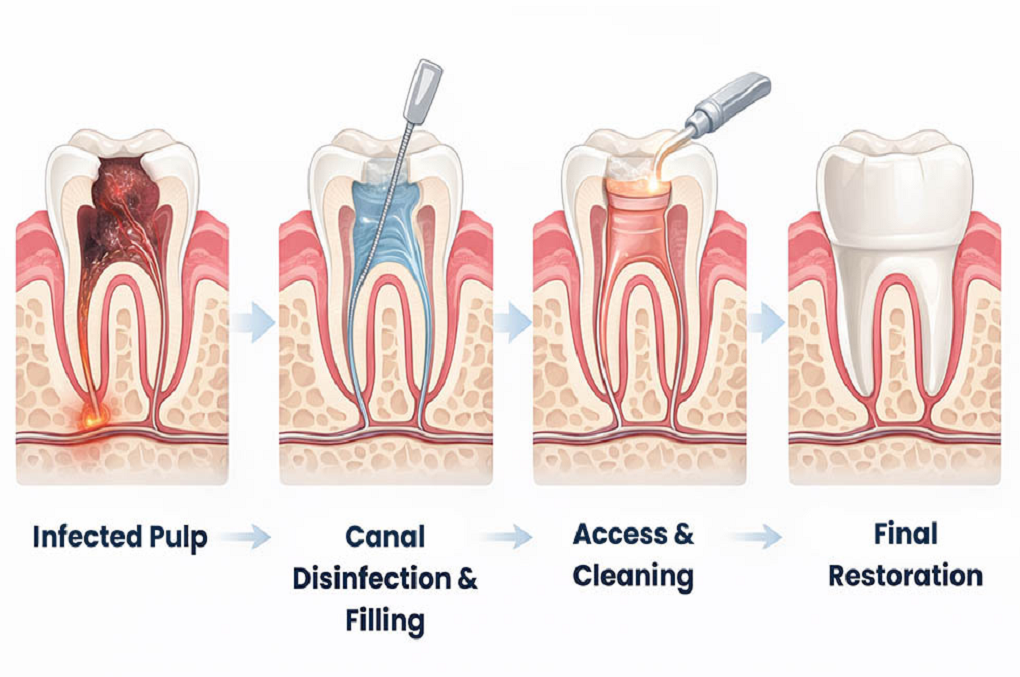
Treatment Process (Step-by-Step)
- Consultation
We talk about your symptoms, your medical history, and the possible treatment options, then we answer your questions as well
- Examination
We take digital X-rays to see the tooth and the surrounding bone, and we do a clinical exam too.
- Local anesthesia
Specific anaesthetic that will numb the tooth and surrounding area – this will be comfortable for the patient.
- Isolation
A rubber dam is placed so the tooth doesn’t get wet, and so it doesn’t become infected while treatment is happening.
- Access and Cleaning
We make a small opening in the crown, remove the infected pulp, then clean and shape the endodontic canals using endodontic files, plus irrigation
- Disinfection
We use antimicrobial solutions and intracanal medicaments inside the cavity, when needed, to help eradicate the bacteria.
- Filling the canals
Canals filled with a biocompatible material (gutta-percha) and sealant to prevent reinfection.
- Temporary or permanent restoration
A filling placed immediately; a crown is often recommended later to restore strength.
- Follow-up and crown placement
Last restoration (most often a crown) made to protect the tooth and restore function.
Advanced Technology We Use
Digital X-rays: Fewer x-rays and fast imaging for correct diagnosis.
No messy putty is needed for crowns with Intraoral Scanner.
CBCT Scan (3D Imaging): This is a test used when there is detailed bone information that needs to be assessed because of the complex anatomy of the roots or surrounding bone.
Better efficiency and accuracy in cleaning canals with apex locators and rotary endodontic systems.
Magnification at the microscope level: Canals are seen in greater detail and more successful.
What technology can do for you: More timely diagnosis, shorter appointments, less pain or discomfort and greater long term success with accurate cleaning and restoration?
Recovery & Aftercare
- Recovery time: It is normal to feel mild soreness for 1-3 days. People usually recover and are able to get back to normal in 24–48 hours.
- Avoid foods that are hard, sticky or very chewy, until final restoration is placed. Don’t bite or chew the treated area until numbness subsides.
- Maintain pain control – over the counter pain medicines (ibuprofen or acetaminophen) typically manage pain. Prescribed medicines, if necessary.
- Oral hygiene advice: Brush and floss regularly, but be a bit careful around the treated tooth the first time, ok? After that try to stay consistent as usual.
- Follow-up visits: You should come back to get your crown in a few weeks, and also plan on regular dental cleanings about once every six months, no rush.
Risks & Possible Complications
- Common side effects: You may notice soreness mild swelling, and some sensitivity for a few days after the treatment, nothing too unusual though.
- Rare complications: Persistent infection, failure to separate the instrument within the canal, failure to clean the complex canal anatomy altogether, may require repeat treatment or referral to an endodontist.
- How risks are minimised: Digital X-rays or CBCT for thorough diagnosis, magnification, rubber dam isolation and follow-up restorations (crowns) to protect the tooth.
When to call the clinic: If the pain gets worse after 48-72 hours, the swelling gets worse, gets fever or symptoms return after they have relieved.
Cost & Insurance
A few things can affect the total cost, like where the tooth is, how complex it turns out to be (a front tooth compared with a molar), whether a CBCT scan is needed, if a post has to be placed, whether you require a core, and also if you need a post placement crown. In other words it depends on the exact situation.
For dental insurance, Kevin harris dentist takes in a wide variety of plans, but the coverage can vary a lot from one plan to another, and sometimes it even offers partial coverage for root canal therapy and crowns.
Accessibility is another big point here: it’s easy to arrange installment payments, plus third party financing options are available, so costs can be spread out across time.
Consultations: we do a full consultation before any treatment, so we can properly check the costs and the possible benefits. Unless the clinic approves, we won’t quote prices online, so you get the right information based on your case.
Why Choose Kevin harris dentist?
We’re proud of our high success rate, especially for complicated root canals.
You also get precision care using modern tools such as Digital X-ray, CBCT, intraoral scanners and microscope magnification which really helps with accuracy.
The whole patient-first approach matters, too: treatment plans are tailored, communication is clear, and pain minimising techniques are used throughout.
Sedation is there if it’s necessary, and the staff stays friendly, with a calm clinic atmosphere that helps people feel more at ease.
If you’re dealing with something urgent, we handle emergency care and we can sometimes offer same day appointments. The goal is to take action quickly, so you can be pain free sooner.
After treatment, we provide clear aftercare instructions and we arrange follow-up sessions, so long term results are more likely and everything stays on track.
Patient Testimonials
- “They explained everything and made me comfortable, and I felt no pain when I left the hospital the same day, highly recommend!” — A.K., Scottsdale, Arizona
- “Staff were kind and efficient, they saved my tooth and the crown looks natural.” — R.S., Scottsdale, Arizona
- “Good service, fast appointment, modern tools and good follow up — good experience.” — P.T., Scottsdale, Arizona
Frequently Asked Questions (FAQs)
Does the procedure hurt?
Local anesthesia is employed during the procedure which means that most patients experience little to no pain. It is normal to be sore after surgery, and can be controlled.
How long does a root canal take?
The time required for a single-visit root canal is dependent on the complexity of the case and may take 60-90 minutes. In some instances, the molar or complicated cases may need two visits.
How much does it cost?
The prices are dependent upon the type of tooth being treated and the complexity of the treatment itself. During consultation, we are able to give you an individual quote.
Does it have insurance?
Many plans will reimburse some of the costs, depending on your insurance coverage. We help with the benefit checks prior to treatment.
What is the duration for the results?
Many root canal treated teeth can last a lifetime or for decades if they are well restored (crowned) and cared for properly.
Related Services
- Emergency Dentist
- Dental Crowns
- Root Canal Retreatment
- Dental Implants
- Teeth Whitening
- Veneers
- Family Dentistry
Local SEO — Areas We Serve
Patients can visit Kevin harris dentist with their patients and enjoy the best services in Central Scottsdale, Arizona and other surrounding areas, such as USA, Arizona, Scottsdale and NY. We are dedicated to providing community care which includes flexible hours, local referrals and outreach to schools and workplaces.
At the End
Don’t let tooth pain take over your day. Book an appointment with Kevin harris dentist in Scottsdale, Arizona today or call now for same-day relief and a compassionate, expert root canal experience.